Carrickfergus District L.O.L. No. 19
Our History
The history of King William III, Prince of Orange, and the formation of Orange Societies and subsequently their re-organisation into The Orange Institution has already been well documented by others, so in this account I will only give a brief outline of the important events.
James II's two children, Mary and Anne, from his first marriage were raised in the Protestant faith. His second marriage in 1673 was to the Italian Princess Mary of Modena, who was a Roman Catholic. When James' heir James Edward was born in 1688, it appeared that James might try to reinstate the Catholic right of succession by force. This led to seven of the most notable Anglican Bishops and Lords seeking help from James' closest male relative, his son-in-law William of Orange-Nassau.
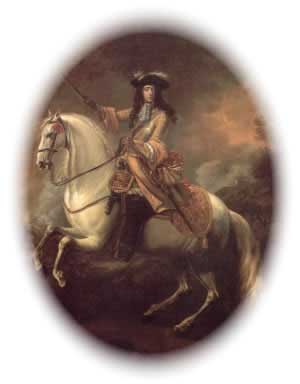
What has since become known as The Glorious Revolution took place, and William landed at Torbay in Devon on 5 November 1688. Following his marriage to James' elder daughter Mary, they were proclaimed and established as joint sovereigns. On 11 June 1690 William set sail from Hoylake on the Wirral Peninsula with a fleet of some seven hundred ships. He landed in Carrickfergus on 14 June 1690 and visited the Castle and Saint Nicholas' Parish Church. (This event is celebrated each year by Carrickfergus District Lodge in the form of a pageant that takes place in the harbour area.) After arriving in Carrickfergus, William marched south where, on 1 July 1690, he defeated James at the Boyne.
In 1795 The Orange Institution was formed, its aims being to support, protect and defend Irish Protestants and to remember the freedom and civil and religious liberty gained by William during his reign.
The first known detail of Orangeism in Carrickfergus was in 1823, when three Lodges paraded on 12 July. In these early years the Order encountered problems in some areas. During a parade in Carrickfergus in 1825 the Orangemen were prevented from proceeding by the Mayor, who took a sword from the Lodge Tyler. During the disturbance that followed, one of the Lodge Drums was broken.
To mark the Boyne Anniversary in 1888 the 12 July Demonstration was held in Carrickfergus. The procession, numbering ten thousand people, began from the Methodist Church and made its way along the Albert Road, North Street, West Street, and Woodburn Road to a field that had been kindly donated to the local Orangemen by a Brother Elliott. The County Grand Master of the time, Rt Worshipful Brother W. H. H. Lyons, chaired the proceedings at the field where he called upon Reverend J. Hamilton Bennett to propose the first resolution, which read as follows:
"At our anniversary this year 1888 we devoutly thank God for the signal defeat of the Spanish Armada in 1588 and for the Glorious Revolution of 1688, gratefully acknowledging that it was by His arm alone by which these deliverances were wrought for our nation, and our religion, and ascribing to Him the honour due to His name."
On the 18 and 19 July 1888 the Grand Orange Council of the World met in Carrickfergus. In conjunction with this meeting several special events were organised. On Wednesday 18 July 1888 The Earl of Erne, Grand Master of Ireland, delegates to the council, local Orangemen and guests, led by Constitutional Flute Band, formed in processional order and proceeded to Saint Nicholas' Parish Church where a divine service was held. After the service the Brethren made their way to the Harbour area where The Earl of Erne stepped on the stone on which The Prince of Orange first set foot in Ireland on 14 June 1690. The Reverend Bennett, Worshipful District Master, said that it was his duty to wish his lordship a hearty welcome, and that he might take it upon himself to tell his lordship that the Orangemen, not only in Carrickfergus but of the whole County round about, were entirely opposed to anything in the nature of an effort to repeal the union between Great Britain and Ireland. The Earl of Erne replied, thanking all for their support. The procession then proceeded to the Town Hall where the Grand Orange Council meetings were being held. After the meeting the Grand Master invited the delegates and a large number of local gentlemen to dinner in the Town Hall, that had been gaily decorated with flags suitable to the occasion.
On 15 February 1907 the Reverend Bennett spoke at the annual reunion of Glenavy District Lodge. Here he attacked Independent Orangeism as "trying to destroy the principles of Protestantism". He said that the Independent Order had tried to break up Unionism in both North Armagh and West Belfast by contesting elections there. He attacked their stance on devolution and said that the Orange Order was not for "peace at any price" in order to come to terms with their old political enemies.
We have come a long way since those days, and Orangeism continues to thrive in Carrickfergus. Our District Lodge has now nine Lodges under its jurisdiction.
In the recent past Carrickfergus District has supplied Members of Parliament, Northern Ireland Assembly Members, and Local Councillors. Our members continue to play a leading role in the community.
We wholeheartedly support County Antrim Grand Orange Lodge and the Grand Orange Lodge of Ireland. We support those Districts and Lodges who are having difficulty because of decisions made by the un-elected Parades Commission.
Please take some time to visit each of the Lodges in Carrickfergus District to learn a little of their history and to view the Roll of Honour. There are also a number of Women's Lodges, Junior Lodges, and Black Preceptories operating in the area covered by Carrickfergus District. Every Lodge also has a Royal Arch Purple Chapter bearing the same number associated with it.